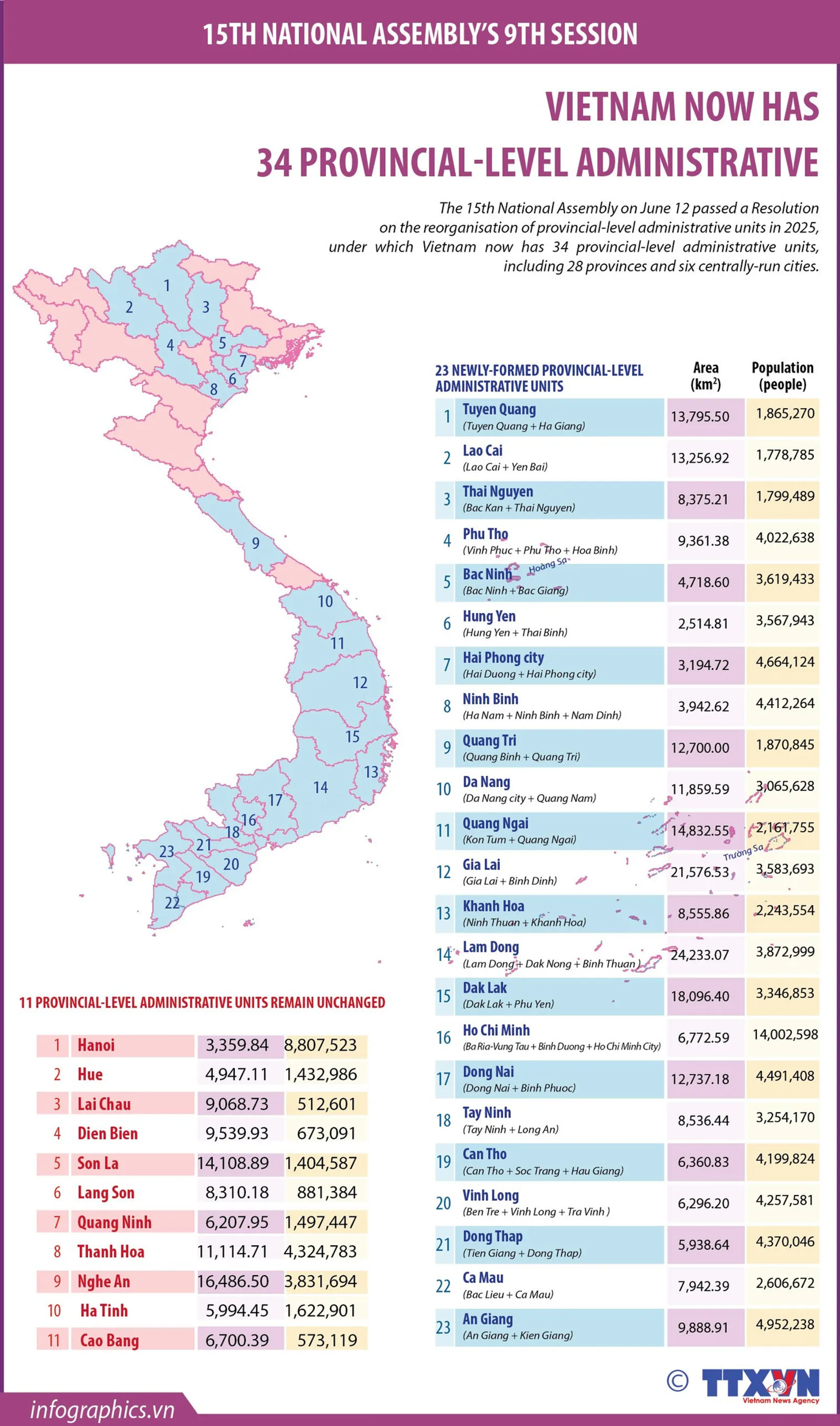
Vietnam reduced its provinces and centrally-run cities from 63 to 34 on 1 July 2025. Nothing about your trip changes: your visa is valid, your flights are unaffected, and every beach, bay and old town is exactly where it was. What changes is the label — Hoi An's address now reads Da Nang, Phong Nha sits in Quang Tri, and Phu Quoc belongs to An Giang.
The practical rule for travelers is simple. Trust the street address and the map pin on your booking; treat the province name as a label that may be mid-update on one system or another until every database catches up.
What exactly changed on 1 July 2025?
Vietnam's National Assembly passed Resolution 202/2025/QH15 on 12 June 2025, merging the country's 63 provincial-level units into 34. The new provinces and cities began operating on 1 July 2025.
The country now has 28 provinces and six centrally-run cities: Hanoi, Hai Phong, Hue, Da Nang, Ho Chi Minh City and Can Tho. Twenty-three of the 34 were formed by merging two or three former provinces. Eleven kept their existing boundaries.
A second change matters more to anyone reading a Vietnamese address. The district level was abolished entirely, so local government now runs on two tiers — provincial and commune — and the number of commune-level units dropped from 10,035 to 3,321. In practice, Vietnamese addresses that used to read street, district, city now read street, ward, city.
Hue is a separate story that often gets folded into this one. Thua Thien Hue province became the centrally-run city of Hue under a resolution adopted on 30 November 2024, effective 1 January 2025 — six months before the big merger, and not part of it.
Which provinces merged into which?
Twenty-three new units were formed. If a province you remember is not in the left column below, it was one of the eleven that did not change.
| New province or city | Former provinces merged | Area (km²) |
|---|---|---|
| Tuyen Quang | Ha Giang + Tuyen Quang | 13,795.50 |
| Lao Cai | Lao Cai + Yen Bai | 13,256.92 |
| Thai Nguyen | Bac Kan + Thai Nguyen | 8,375.21 |
| Phu Tho | Vinh Phuc + Phu Tho + Hoa Binh | 9,361.38 |
| Bac Ninh | Bac Giang + Bac Ninh | 4,718.60 |
| Hung Yen | Hung Yen + Thai Binh | 2,514.81 |
| Hai Phong (city) | Hai Duong + Hai Phong | 3,194.72 |
| Ninh Binh | Ha Nam + Ninh Binh + Nam Dinh | 3,942.62 |
| Quang Tri | Quang Binh + Quang Tri | 12,700.00 |
| Da Nang (city) | Da Nang + Quang Nam | 11,859.59 |
| Quang Ngai | Kon Tum + Quang Ngai | 14,832.55 |
| Gia Lai | Gia Lai + Binh Dinh | 21,576.53 |
| Khanh Hoa | Ninh Thuan + Khanh Hoa | 8,555.86 |
| Lam Dong | Lam Dong + Dak Nong + Binh Thuan | 24,233.07 |
| Dak Lak | Dak Lak + Phu Yen | 18,096.40 |
| Ho Chi Minh City | Ba Ria–Vung Tau + Binh Duong + Ho Chi Minh City | 6,772.59 |
| Dong Nai | Dong Nai + Binh Phuoc | 12,737.18 |
| Tay Ninh | Tay Ninh + Long An | 8,536.44 |
| Can Tho (city) | Can Tho + Soc Trang + Hau Giang | 6,360.83 |
| Vinh Long | Ben Tre + Vinh Long + Tra Vinh | 6,296.20 |
| Dong Thap | Tien Giang + Dong Thap | 5,938.64 |
| Ca Mau | Bac Lieu + Ca Mau | 7,942.39 |
| An Giang | An Giang + Kien Giang | 9,888.91 |
The eleven unchanged units are Hanoi, Hue, Cao Bang, Lang Son, Lai Chau, Dien Bien, Son La, Quang Ninh, Thanh Hoa, Nghe An and Ha Tinh. If your trip is Hanoi and Halong Bay, nothing on your paperwork moved at all.
Which places do I now look up under a different province?
These are the ones that come up on almost every itinerary we write. The place has not moved a meter; only the province above it has changed.
| Destination | Province before | Province or city now |
|---|---|---|
| Sa Pa, Fansipan | Lao Cai | Lao Cai (now includes Yen Bai) |
| Mu Cang Chai | Yen Bai | Lao Cai |
| Ha Giang Loop, Dong Van | Ha Giang | Tuyen Quang |
| Mai Chau | Hoa Binh | Phu Tho |
| Ba Be Lake | Bac Kan | Thai Nguyen |
| Trang An, Tam Coc | Ninh Binh | Ninh Binh (now includes Ha Nam, Nam Dinh) |
| Cat Ba Island | Hai Phong | Hai Phong (Cat Hai special zone) |
| Phong Nha–Ke Bang | Quang Binh | Quang Tri |
| Hoi An, My Son | Quang Nam | Da Nang |
| Quy Nhon | Binh Dinh | Gia Lai |
| Nha Trang | Khanh Hoa | Khanh Hoa (now includes Ninh Thuan) |
| Mui Ne, Phan Thiet | Binh Thuan | Lam Dong |
| Vung Tau | Ba Ria–Vung Tau | Ho Chi Minh City |
| My Tho, Mekong cruises | Tien Giang | Dong Thap |
| Phu Quoc | Kien Giang | An Giang (Phu Quoc special zone) |
| Con Dao | Ba Ria–Vung Tau | Ho Chi Minh City (Con Dao special zone) |
Thirteen island districts became special zones under the province or city that now holds them. Phu Quoc, Con Dao, Cat Ba (within Cat Hai), Van Don, Co To and Ly Son are the ones travelers visit. A special zone is an administrative status, not a restricted area: there is no permit, no extra fee and no different entry rule.
Does this change my Vietnam visa or e-visa?
No. Visa rules, e-visa eligibility, fees and permitted stays were untouched by the merger, and entry points are listed by port name rather than by province, so your approved airport or land crossing is unchanged.
Two small things to get right on the form. The e-visa application asks for the address where you will stay — copy the province exactly as it appears on your hotel confirmation rather than from an older guidebook. And a visa or e-visa already issued with a former province name on it stays valid; it will not be questioned at immigration.
Our complete Vietnam e-visa guide walks through the form field by field. If you want a cross-check on province names before you submit, send us the hotel name and we will confirm it.
Will my hotel booking still be correct?
Yes. Hotels kept their buildings, phone numbers, GPS coordinates and contracts. What may look odd is the address line, because booking platforms update at different speeds — the same property can show "Hoi An, Quang Nam" on one site and "Hoi An, Da Nang" on another in the same week.
Three habits solve this completely:
- Save the hotel's Google Maps pin, not just its written address. A pin does not change when a province does.
- Keep the booking confirmation on your phone. Whatever province it names, it identifies the property.
- When giving an address to a driver, use the landmark and street — "Hoi An Old Town" or "Cat Cat village road" — rather than the administrative unit. No driver in Vietnam navigates by province name.
Do airports, trains and domestic flights change?
No. Airport names and IATA codes are the same — HAN for Hanoi, DAD for Da Nang, CXR for Cam Ranh, SGN for Ho Chi Minh City, PQC for Phu Quoc. Train stations, bus terminals and domestic flight routes are unchanged, and tickets bought before the merger remain valid.
The only place you may notice anything is a booking site whose drop-down menu still lists 63 provinces. Pick the closest match or search by city name; the ticket itself is issued against the station or airport.
Will Vietnam merge provinces again?
Not according to the government. On 5 March 2026, Phan Trung Tuan, director of the Ministry of Home Affairs' Department of Local Government, said at the government's regular press briefing that there is no policy to reorganize or merge provincial- or commune-level units nationwide, and dismissed circulating rumors of a further cut to 16 provinces.
The National Assembly's Vice Chairman, Nguyen Khac Dinh, made the same point at a late-2025 Standing Committee session. For trip planning in 2026 and 2027, the 34-unit map is the one to use.
Local tip from our guides
- Search by the place name, not the province. Google Maps, Grab and Booking.com all still recognize "Hoi An", "Sa Pa", "Mui Ne" and "Ha Giang". These names remain in daily use and on every road sign; only the administrative unit above them changed.
- Expect a ward name you have never seen. Some new wards carry the old province name — a Hoi An hotel may now sit in "Hoi An Tay Ward", and a Ha Giang guesthouse in "Ha Giang 1 Ward". That is normal, not a typo.
- If you are driving the Ha Giang Loop, your permits and plates now say Tuyen Quang. Rental paperwork from Hanoi will reference the new province. Nothing about the route, the passes or the overnight stops has changed.
- Older guidebooks are still right about everything except the province. A 2023 guidebook's directions, distances and opening hours are fine. Cross-check only the administrative names.
FAQ
Da Nang. Quang Nam province was merged into Da Nang city on 1 July 2025, and Hoi An was reorganized into three wards and one commune within it. Officials were still discussing an international name for the town in January 2026 to protect its UNESCO standing, since it no longer has city status.
Thirty-four: 28 provinces and six centrally-run cities — Hanoi, Hai Phong, Hue, Da Nang, Ho Chi Minh City and Can Tho. The figure has been stable since 1 July 2025.
No. Kien Giang merged into An Giang, so Phu Quoc is now a special zone of An Giang province. Flights, ferries and hotels are unaffected, and PQC is still the airport code.
No. A valid visa or e-visa remains valid regardless of the province name printed on it or on your accommodation booking.
Because the district level was abolished nationwide on 1 July 2025. Vietnamese addresses now go street, ward, province or city, with the district line removed.
No. Quang Ninh is one of the eleven units that kept its boundaries, so Halong Bay is still in Quang Ninh. Cat Ba, on the other side of the bay, is in Hai Phong as before, now within the Cat Hai special zone.
No. The merger reorganized government administration. It changed no entry rules, no tourist permits and no access to any destination.
Planning a trip around the new map?
If you are putting an itinerary together and the province names are making it hard to compare one route with another, send us the dates and the places you have in mind and we will lay it out properly — distances, drive times and what realistically fits. Message David Ng on WhatsApp at +84 988 660 505 or email sales@worldmatetravel.com. We reply within 24 hours, and we take no payment through the website.
You may also find our month-by-month guide to the best time to visit Vietnam by region and our complete guide to solo travel in Vietnam useful while you plan.