Five things have to be right before you board: a passport valid at least six months beyond your arrival date, either a visa or a confirmed exemption for your nationality, the free online pre-arrival declaration, travel insurance that covers what you actually plan to do, and clothing matched to the region you are visiting rather than to “Vietnam” as a whole.
The pre-arrival declaration is the one most travelers have never heard of. Since 15 April 2026 Vietnam has required international arrivals to submit a short online declaration and show the resulting QR code at immigration, and by June 2026 the requirement applied at airports nationwide. It is free, it takes about ten minutes, and you can file it up to three days before you fly.
Do I need a visa for Vietnam, or can I enter visa-free?
It depends entirely on your passport. Twenty-four nationalities currently get 45 days with no visa at all, around fifteen more get between 14 and 90 days, and everyone else uses the e-visa, which is open to citizens of every country.
Two government resolutions set the 45-day exemptions:
| Nationalities | Visa-free stay | Conditions |
|---|---|---|
| Germany, France, Italy, Spain, United Kingdom, Russia, Japan, South Korea, Denmark, Sweden, Norway, Finland | 45 days | Any purpose, any passport type. Resolution 44/NQ-CP, valid to 14 March 2028 |
| Belgium, Bulgaria, Croatia, Czech Republic, Hungary, Luxembourg, Netherlands, Poland, Romania, Slovakia, Slovenia, Switzerland | 45 days | Tourism only. Resolution 229/NQ-CP, valid to 14 August 2028 |
Note that last column. The March 2025 resolution covers business travel too; the twelve added in August 2025 cover tourism only.
The remaining exemptions sit on older bilateral agreements:
| Stay | Nationalities | Notes |
|---|---|---|
| 90 days | Chile, Panama | |
| 30 days | Belarus, Cambodia, Kazakhstan, Kyrgyzstan, Laos, Malaysia, Mongolia, Singapore, Thailand | Belarus is 30 days per visit, capped at 90 days in any one year |
| 21 days | Philippines | |
| 14 days | Brunei, Indonesia, Myanmar |
If you hold an Indonesian passport, this changed recently. The visa-free stay dropped from 30 days to 14 on 15 July 2026, and now covers tourism and family visits only, as Vietnam moved to the ASEAN framework limit for ordinary passports. If you are planning more than two weeks, you need an e-visa.
The lower tiers in that second table rest on bilateral agreements rather than a single published resolution, and the Indonesian change suggests other ASEAN stays may follow. Confirm your own nationality with the Immigration Department before you book anything non-refundable.
The e-visa is open to citizens of every country and territory. It allows up to 90 days, single or multiple entry, costs US$25 for single entry or US$50 for multiple entry, and is normally issued within three working days. Apply only at the government portal, evisa.gov.vn. Our complete Vietnam e-visa guide walks through the form field by field and lists all 83 approved entry points.
Two mistakes we see every month: paying a third-party site three times the government fee, and arriving at a port that was not the one named on the e-visa. The port matters.
What is the pre-arrival declaration, and do I really have to do it?
Yes, if you are not traveling on a Vietnamese passport. It is separate from your visa and does not replace it.
The declaration launched at Tân Sơn Nhất International Airport in Hồ Chí Minh City on 15 April 2026, reached Phú Quốc and then Hà Nội’s Nội Bài and Đà Nẵng through June 2026, and the US Mission in Vietnam advised on 17 June 2026 that it applies at all airports in Vietnam.
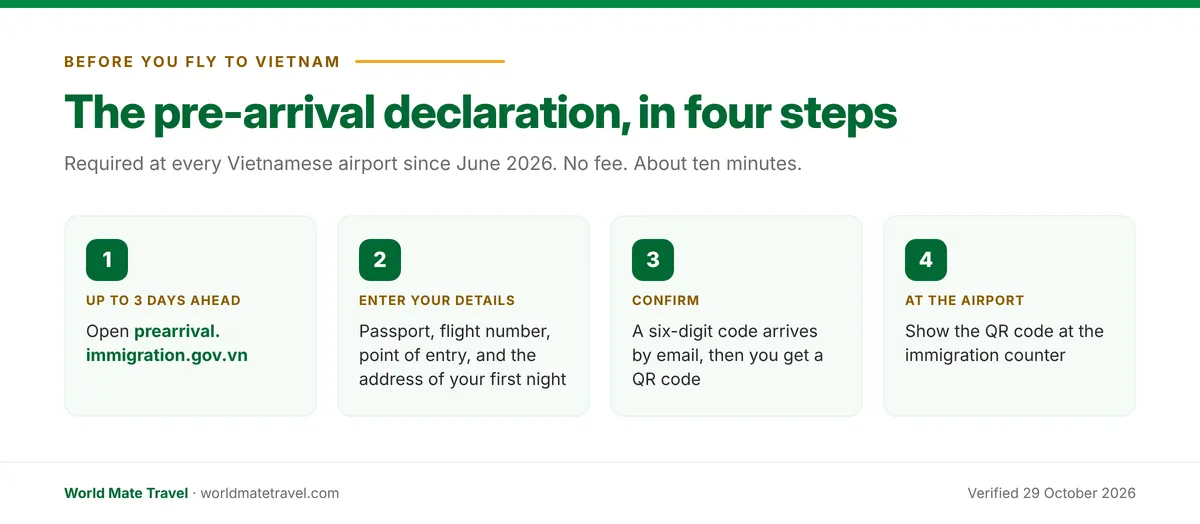
Here is how it works:
- File it at prearrival.immigration.gov.vn — on the day you arrive or up to three days before.
- There is no fee.
- You will need your passport details, phone and email, visa details if you have one, flight number, point of entry, your purpose of travel, and the address where you are staying the first night.
- A six-digit code is emailed to you to confirm submission; you then receive a QR code.
- Show that QR code at the immigration counter.
You can also complete it on arrival from a QR code in the immigration hall, but that means filling in a form on your phone in a queue after a long flight. File it at home.
The form asks for your first night’s accommodation address, so ask your operator for it before you leave — we send it to our travelers with their final documents for exactly this reason.
Every official announcement we can find refers to airports. If you are crossing overland from Cambodia or Laos, file the declaration anyway — it costs nothing, and we have not seen it confirmed either way for land and sea crossings.
How valid does my passport need to be?
At least six months beyond your arrival date, and with blank pages for stamps. This applies whether you use an e-visa or enter under an exemption.
Check the expiry date now, not the week before you fly. Renewal takes three to six weeks in most countries, and a passport with five months left will stop you at airline check-in — the airline carries the liability, so they enforce it strictly.
What should I pack for Vietnam’s weather?
Pack for the specific regions on your itinerary, because the north and south can differ by 15°C on the same day.
| Region | Cool season | What that means for your bag |
|---|---|---|
| North (Hanoi, Sa Pa, Hà Giang) | December–February | A real jacket. Sapa can approach freezing; mountain hotels often have no central heating |
| Central (Huế, Da Nang, Hội An) | Heaviest rain roughly October–December | A light rain shell, quick-dry clothing, sandals you don’t mind soaking |
| South (Ho Chi Minh City, Mekong Delta) | Warm year-round | Lightweight cotton or linen, plus a layer for aggressive air conditioning |
Beyond that: breathable long-sleeved shirts and long pants for temples and for sun, broken-in walking shoes, a wide-brimmed hat, high-SPF sunscreen, insect repellent, and a compact umbrella.
At temples and pagodas, cover shoulders and knees. This is not a formality — at some sites you will be turned away at the gate.
To match your dates to the right regions, see our month-by-month guide to the best time to visit Vietnam by region.
What health precautions do I actually need?
No vaccination certificate is required to enter Vietnam. What you need is a conversation with a travel clinic six to eight weeks before you fly.
Clinics commonly discuss hepatitis A and B, typhoid, tetanus boosters, and Japanese encephalitis for longer rural stays. What applies to you depends on your medical history and itinerary, so that is a decision for a doctor who has both in front of them.
Pack prescription medication in its original labeled packaging, a small kit with oral rehydration salts and antidiarrheal tablets, and repellent containing DEET or picaridin. Tap water is not safe to drink anywhere in Vietnam, but bottled and filtered water costs very little.
Travel insurance is not a condition of entry, but it is the one item we would not let a traveler skip. Check that your policy covers motorbike riding, trekking and scuba diving if any are on your plan — standard policies frequently exclude all three, and a motorbike claim without a valid license is almost never paid.
How much cash should I bring, and what has to be declared?
You must declare cash to customs if you are carrying more than US$5,000 or more than VND 15,000,000 on entry or exit, under Circular 15/2011/TT-NHNN. Below those thresholds, no declaration is needed.
Bring a modest amount of clean, untorn notes to exchange and rely on ATMs after that. Exchange at banks or licensed gold and jewelry shops in the cities rather than at the airport, take out larger amounts less often to spread the withdrawal fee, and keep small notes for taxis, markets and street food.
Cards work in hotels, restaurants and shops in all the main cities. Markets, rural homestays, street vendors and most local transport are cash. Our guide to exchanging money in Vietnam covers where the good rates are.
How do I get online and get around after I land?
Buy a local SIM or activate an eSIM, and use a ride-hailing app rather than hailing a taxi from the curb.
SIM cards are sold in the arrivals hall at every international airport. Bring your passport: registration in Vietnam requires identity verification, so an unregistered card from a street stall can be cut off without warning. An eSIM bought before you fly avoids the queue entirely.
Grab has the widest coverage and Xanh SM is a solid electric-taxi alternative in the major cities. Both show the fare before you accept, which removes the most common tourist overcharge. Between cities, domestic flights are cheap and frequent, and the sleeper train between Hanoi and Da Nang is slower but genuinely scenic.
One address note specific to 2026: Vietnam reduced its provinces and cities from 63 to 34 on 1 July 2025, and many were merged or renamed. Hotel confirmations and older maps may use different province names for the same place; the street address is what matters.
What should I know about etiquette and electricity?
Vietnam runs on 220V at 50Hz, and sockets take Type A, C and F plugs.
Devices labeled “100–240V, 50–60Hz” — nearly all modern phones, laptops and camera chargers — work with a simple plug adapter. Older 110V-only appliances such as some hair dryers need a voltage transformer, not just an adapter. Our guide to electric plugs and voltage in Vietnam has the socket photos.
On etiquette, a short list goes a long way:
- Remove your shoes when entering a home, and at many temples.
- Ask before photographing people, especially elders and ethnic minority communities in the north.
- Learn four phrases: xin chào (hello), cảm ơn (thank you), xin lỗi (excuse me), tạm biệt (goodbye). The effort is noticed.
- Bargaining is normal in markets and not in shops with marked prices. Stay cheerful; a negotiation that turns cold is a lost one.
Local tip from our guides
- File the pre-arrival declaration three days out, not the day you fly. The portal only lets you select today or the next two or three arrival days, so set a phone reminder. Travelers who forget end up filling in a form on their phone in the immigration queue.
- Photograph your passport, visa, insurance certificate and pre-arrival QR code and email them to yourself. Phones die and bags go missing.
- Carry your passport on SIM-buying day and at every hotel check-in. Vietnamese hotels must register guests, so a photocopy without the original slows everything down.
- For Sapa and Ha Giang between December and February, pack a real jacket, not a fleece. Every season we meet travelers who packed for a tropical holiday and spend their first morning buying a coat in Hanoi.
Frequently asked questions
No. Travel insurance is not an entry requirement for visa-exempt travelers or e-visa holders. We still treat it as essential, particularly for anything involving motorbikes, trekking or diving, which many standard policies exclude.
Both. Hotels, restaurants and shops in the main cities take cards without issue. Markets, street food, rural homestays and most local transport are cash only, so carry some small notes every day.
The e-visa application does not require proof of onward travel. Airlines sometimes ask at check-in as a condition of carriage, so have a return or onward booking available on your phone.
No. Use bottled or filtered water throughout Vietnam, including for brushing your teeth if your stomach is sensitive. Ice in established restaurants and cafes is made from treated water and is generally fine.
Overstaying is an administrative offense handled at the airport on departure, and it can mean a fine and a significant delay to your flight. If your plans change, deal with an extension before your permitted stay expires rather than at the airport.
Because Vietnam consolidated 63 provinces and cities into 34 on 1 July 2025, and many were merged or renamed. The street address and city are reliable; the province name on older maps may not be.
For travel over Tet, Christmas and New Year, three to six months. For other months, six to eight weeks is usually enough for good hotels, though Sapa and the Halong Bay cruises with the best cabins go earlier than people expect.
Plan the trip, not just the paperwork
Once the paperwork is sorted, the harder question is what to do with your days, and that depends on your month and your regions. Send us your dates and we will tell you honestly whether they work for the places you have in mind, then build a private itinerary around them. Message David Ng on WhatsApp at +84 988 660 505 or email sales@worldmatetravel.com — a reply within 24 hours, and no payment is taken on our website.