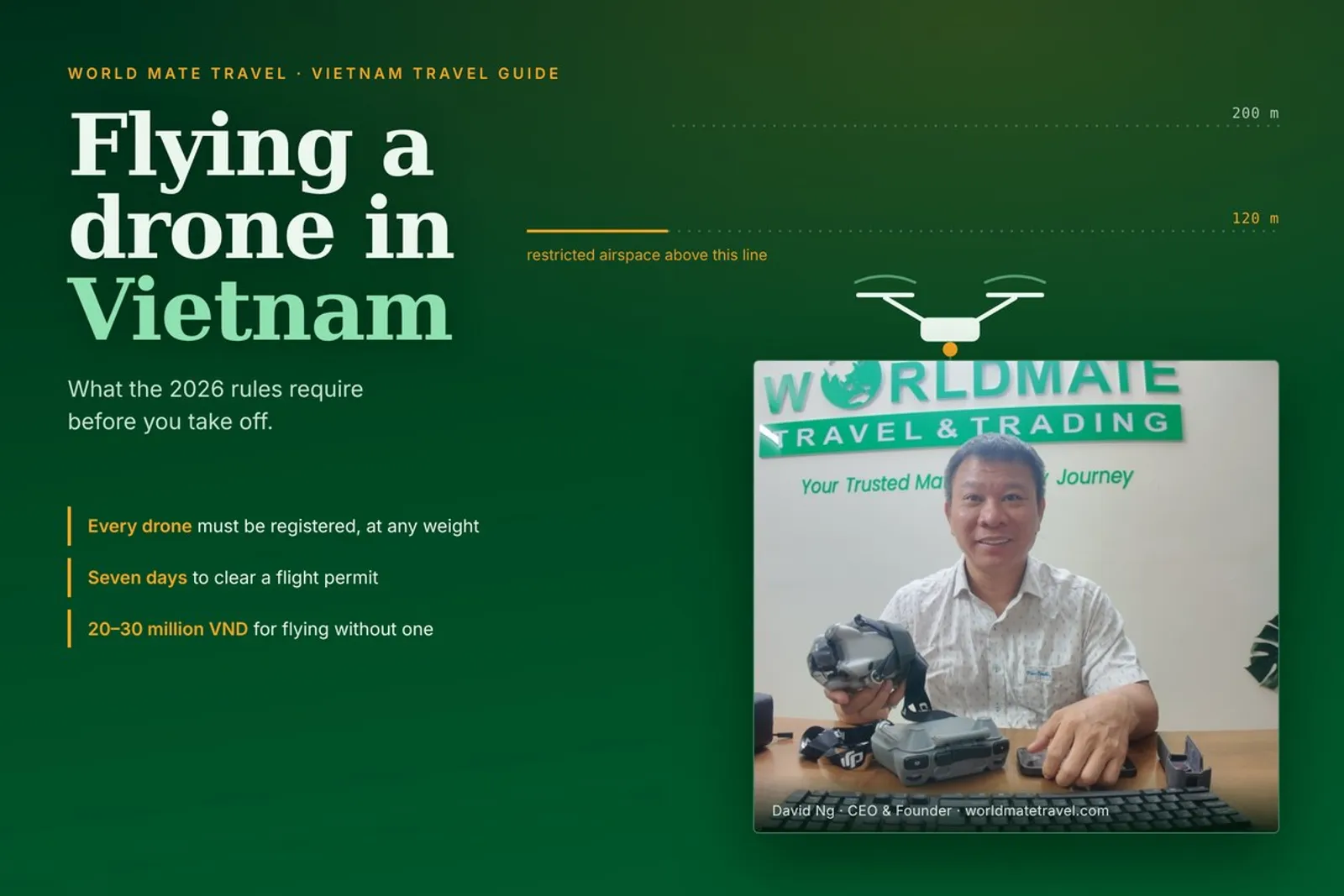
Yes, you can fly a drone in Vietnam, but not casually, and not alone if you are a foreign visitor. Since the Law on People's Air Defence (No. 49/2024/QH15) took effect on 1 July 2025, every drone in the country must be registered before it is used, and almost every flight needs a permit from the military, filed at least seven days in advance. The only broad exemption from the permit covers a recreational drone under 0.25 kg, flown within sight and outside every prohibited and restricted zone.
Registration has no weight exemption at all. A 249-gram drone still has to be registered with the police before it leaves your bag. Flying without a permit is an administrative offence carrying a fine of 20-30 million VND for an individual, with the aircraft liable to confiscation.
Written by David Ng, CEO & Founder of World Mate Travel and a licensed Vietnam tour guide with 25 years of experience. Updated 29 October 2026.
What a visitor needs at a glance
| What you need | When it applies | Who handles it |
|---|---|---|
| Drone registration | Every drone, any weight | Provincial police |
| Identification number and flight-management device | Every drone, since 20 July 2026 | Police, during registration |
| Remote pilot licence | Drones 0.25 kg and over, since 1 July 2026 | Ministry of National Defence |
| Per-flight permit | All flights except recreational under 0.25 kg outside restricted airspace | Military, filed 7 days ahead |
| Vietnamese sponsor | Every foreign operator | A Vietnamese company, body or individual |
| Site permission | Heritage sites, national parks, many resorts | The site manager |
What are the drone rules in Vietnam in 2026?
Six legal instruments now govern drone use, and together they displaced the framework most travel articles still quote. Two ministries share the file: the police register the aircraft, the military permits the flight. Clearing one of them is not clearing both.
Law 49/2024/QH15, in force 1 July 2025. Law on People's Air Defence. Requires registration of every drone before use and sets the under-0.25 kg permit exemption.
Law 98/2025/QH15, in force 1 July 2025. Moves airport-area consent to the Ministry of Construction, and lets district and commune military commanders and border guard units ground or seize a drone.
Decree 288/2025/ND-CP, in force 5 November 2025. Registration and operator conditions, pilot licence classes, permit procedure and deadlines. Article 19 clauses 1 and 3 apply from 1 July 2026.
Circular 146/2025/TT-BQP, signed 25 December 2025. Delegates permit authority down to military region and provincial level.
Decree 282/2025/ND-CP, in force 15 December 2025. The penalty schedule, amended by Decree 347/2026/ND-CP from 15 September 2026.
Circular 78/2026/TT-BCA, in force 20 July 2026. Registration procedure, the identification number and the mandatory flight-management device.
Prohibited and restricted zones remain set by Decision 18/2020/QD-TTg. One quick test for any Vietnam drone article you read: if it cites Decree 36/2008/ND-CP or Decree 147/2013/ND-CP for the fines, it predates the current law and its numbers are wrong.
Do I need to register my drone in Vietnam?
Yes, at every weight. Article 19 clause 1 of Decree 288/2025/ND-CP states that a flying vehicle must hold a valid registration certificate or temporary registration certificate, and it sets no weight threshold. The under-0.25 kg carve-outs elsewhere in the law cover the flight permit, the minimum operator age and the pilot licence, never registration.
Registration is handled by the provincial police where the owner lives or is based. A provincial department may delegate first-time registration of drones under 2 kg to commune-level police, and foreign diplomatic missions register with the Department of Cyber Security and High-Tech Crime Prevention.
From 20 July 2026, Circular 78/2026/TT-BCA added two elements. Each registered aircraft receives a registration number that works like a licence plate, formatted AB-X-N1N2N3N4-CD, where AB is the two-digit provincial code, X is C for powered or K for unpowered, the four digits run from 0001 to 9999, and the closing pair is TN for a Vietnamese registrant or NN for a foreign one. The police then fit a flight-management device, an electronic tag or integrated unit tied to that number, as a required step of registration. A manufacturer's serial number is not a Vietnamese registration.
Expect to produce proof of lawful ownership: an import permit and customs declaration for an imported aircraft, or a purchase invoice or transfer document. The drone must meet technical standards issued or recognised by the Ministry of National Defence, and you bring it in physically to be inspected.
Pilot licensing runs alongside. From 1 July 2026, anyone flying a drone of 0.25 kg or more needs a remote pilot licence. Class A covers 0.25 kg up to under 2 kg within visual line of sight, Class B covers 2 kg and above, beyond-visual-line-of-sight flying, or pre-programmed flights. Licences last ten years, and an international certificate recognised by the Ministry of National Defence can stand in place of a Vietnamese one.
Does a drone under 250 g need a permit in Vietnam?
No flight permit, provided four conditions hold at the same time. Article 30 clause 3 of the Law and Article 21 of Decree 288/2025/ND-CP exempt an aircraft that has a maximum take-off weight under 0.25 kg, is flown for recreation rather than commercial work, stays outside every prohibited and restricted zone, and stays within the operator's visual line of sight.
That aircraft is also exempt from the pilot licence and the minimum-age rule. It is not exempt from registration.
The third condition is where the exemption usually collapses. Airspace above 120 m is itself a restricted zone, as are crowded places and a 25,000 m band inland from the Chinese border. A sub-250 g drone hovering over a market, or sitting at 150 m above a viewpoint, has already left the exemption behind.
How do I get a drone flight permit in Vietnam?
Through the military, and as a foreign national through a Vietnamese sponsor. Article 19 clause 6 of Decree 288/2025/ND-CP requires a foreigner flying in Vietnam to have a Vietnamese agency, organisation or individual act as guarantor, and Article 22 requires that guarantee inside the permit file itself.
Circular 146/2025/TT-BQP sets the level you apply to, by altitude:
Below 50 m above terrain, within one province: Provincial Military Command.
Below 120 m above terrain, within one military region: Military Region Command.
Below 120 m above terrain, within Hanoi: Hanoi Capital Command.
Anywhere in Vietnam's airspace or flight information region: Operations Department, General Staff.
Prohibited zones and the restricted zones around airports are carved out of the three lower levels and escalate to the top. Where a flight affects civil aviation, the Ministry of Construction must also consent, a role that moved from the Ministry of Transport under Law 98/2025/QH15.
The timetable sits in Article 22 of Decree 288/2025/ND-CP. File at least seven days before the flight, or at least twelve days if it affects published air routes, procedures or an airport, since a NOTAM must be issued. The authority decides within five working days of a complete file. An incomplete file comes back within three working days, and the time you spend fixing it does not count toward the deadline. A permit covers a single flight operation for up to 30 days.
Then comes the step that catches people out. Under Article 25 you must still coordinate with the designated unit at least 24 hours before flying, and seven days ahead if the flight affects civil aircraft. Flights at 50 m or above require advance notification, and anything above 200 m falls under direct military supervision.
Note also who can stop you on the ground. Law 98/2025/QH15 gives district-level defence command chiefs, commune military command chiefs and border guard commanders the power to order a drone down in their area, and commune commanders can order suppression or temporary seizure. You do not have to be near an airport to meet someone with that authority.
For a two-week holiday, that is the honest arithmetic. The paperwork moves slower than most itineraries, which is why aerial footage in Vietnam is normally arranged through a licensed local company rather than flown by the visitor.
Where can't I fly a drone in Vietnam?
Prohibited and restricted zones are set by Decision 18/2020/QD-TTg, and the Ministry of National Defence published the national zone map on 15 June 2025 at cambay.mod.gov.vn. Check it before you pack, not after you land.
| Zone | Limit |
|---|---|
| Airports and aerodromes with civil or military traffic | Prohibited. A rectangle 15,000 m beyond each runway threshold and 5,000 m either side of the centreline, at all altitudes |
| Key national defence sites and special military zones | Prohibited within 500 m horizontally, all altitudes |
| Party, government and ministry headquarters; diplomatic missions | Prohibited within 200 m horizontally, all altitudes |
| Military camps, depots, detention facilities, listed security works | Prohibited within 500 m horizontally, all altitudes |
| Published airways and corridors in AIP Vietnam | Prohibited |
| Above 120 m above terrain | Restricted |
| Crowded places | Restricted |
| Inland from the Chinese border | Restricted to 25,000 m, all altitudes |
| Inland from the Lao and Cambodian borders | Restricted to 10,000 m, all altitudes |
| Beyond the airport prohibited boundary | Restricted 3,000 m wide by 5,000 m long, below 120 m |
Read the airport rectangle twice. It is far larger than most visitors assume, and cities are now mapping it ward by ward. On 27 October 2026, Ho Chi Minh City published a public-information plan covering the 63 commune-level units that fall inside the no-fly area around Tan Son Nhat and Con Dao airports.
Individual sites layer their own rules on top. On 16 July 2026 the Hue Monuments Conservation Centre published visitor regulations for the Hue heritage complex barring flycam use, filming and performances without permission, with staff able to end a visit on the spot. National parks and managed heritage areas work the same way: national clearance never substitutes for the site manager's consent.
Northern Vietnam deserves a specific warning. Much of Ha Giang, Lao Cai and Cao Bang falls inside the 25,000 m restricted band along the Chinese border, which is to say a good share of the scenery people most want to film. Vietnam's 2025 reorganisation into 34 provinces and cities also renamed boundaries that older maps still show, so work from the official zone map rather than a guidebook.
Why has enforcement tightened in 2026?
Because drones have been stopping aircraft. The Ministry of Public Security issued a national warning on 12 August 2026 setting out the scale: 34 UAV incidents nationwide in 2025, at airports in Hanoi, Thanh Hoa, Binh Dinh and Ho Chi Minh City, and 17 more in the first half of 2026, at airports in Hanoi, Hai Phong, Da Nang, Khanh Hoa and Ho Chi Minh City.
The costs are documented. Between 17 and 24 February 2026, Vietnam Airlines reported roughly 5.6 billion VND in losses and about 9,200 passengers affected by delays and schedule changes. Da Nang International Airport and the operators there estimated direct losses above 10 billion VND. On 22 February 2026, flycams were detected inside the Da Nang flight zone during the Tet holiday.
That history is why a drone near a runway is no longer treated as a paperwork matter. Article 278 of the Penal Code, obstructing air traffic, reaches up to 15 years' imprisonment in especially serious cases, and clause 4 allows liability, a fine of 10-50 million VND, non-custodial reform of up to two years, or three months to two years' imprisonment, even where no serious consequence actually occurred, if the act could realistically have caused one.
What are the fines for flying a drone illegally in Vietnam?
Penalties sit in Article 8 of Decree 282/2025/ND-CP of 30 October 2025, in force from 15 December 2025 and amended by Decree 347/2026/ND-CP from 15 September 2026. Figures below are for individuals. Organisations pay double.
| Conduct | Fine (VND) |
|---|---|
| Flying an unregistered drone, or outside the permitted time, place, area, coordinates or limits | 2,000,000 – 3,000,000 |
| Photographing or mapping prohibited defence or security areas | 6,000,000 – 8,000,000 |
| Filming or photographing from the air without permission | 8,000,000 – 9,000,000 |
| Flying contrary to the content of the permit | 9,000,000 – 12,000,000 |
| Ignoring orders from flight management or monitoring authorities | 12,000,000 – 15,000,000 |
| Flying without a flight permit | 20,000,000 – 30,000,000 |
| Using a drone that obstructs or endangers other aircraft | 30,000,000 – 40,000,000 |
Supplementary penalties include confiscation of the drone and suspension of flight rights for three to six months. Criminal liability under Article 278 of the Penal Code applies on top where a flight endangers aircraft.
Two points are worth isolating. Vietnamese law treats aerial filming as its own authorisation, so permission to fly is not permission to film. And there is a separate, low-value fine simply for operating an unregistered aircraft, which is the one a visitor with a 249-gram drone is most likely to collect. For converting these amounts, see our guide to exchanging money in Vietnam.
Can I bring my drone into Vietnam as a tourist?
Carrying a personal drone in your luggage is a customs question, and it is the least well-documented part of the system. Vietnamese law requires an import permit and customs declaration as proof of ownership when registering an imported aircraft, but no published arrival procedure covers a visitor hand-carrying a single drone for personal use.
What is not in doubt: bringing the drone in gives you no right to fly it. The Ministry of Public Security put it plainly in its August 2026 warning, that registration alone does not authorise flight. Registration with the police, and in most cases a military permit, come first, and neither can be arranged at the airport. Arrive with a drone and no paperwork, and the lawful option is to leave it in the bag.
If you are still at the planning stage, settle your entry documents early as well. Our Vietnam e-visa guide covers that side of the trip.
Local tips from our guides
Open the zone map before you book the flight, not after you land. Our office is in Hanoi, where the Capital Command handles flights below 120 m, and the prohibited rectangle around Noi Bai airport still runs 15,000 m past each runway end, reaching much further into the suburbs than visitors expect.
Put the seven-day lead time at the start of the itinerary, not the end. A file submitted on arrival is already too late for a ten-day trip, and the twelve-day rule bites as soon as an airport or published route is involved.
Ask the site before you ask the state. Hue's monuments, managed national parks and many resorts restrict drones under their own authority, and a national permit does not override a site manager's refusal.
Treat aerial filming as a second permission. The 8-9 million VND penalty for unauthorised aerial photography is charged separately from the flight.
If you fly FPV, assume Class B. Goggles mean beyond visual line of sight, which moves you out of the light-touch bracket regardless of how little the aircraft weighs.
Expect to be challenged by someone local. Since Law 98/2025/QH15, commune-level military commanders and border guard units can order a drone down where you are standing.
Frequently asked questions
A permit for a single flight operation runs up to 30 days. Official-duty and agricultural flights can be granted up to 180 days, and flights inside designated traditional flight zones up to 360 days.
There is no tourist exemption for either. Both fall under the same registration and permit rules, and parts of the northern border region sit inside the 25,000 m restricted band. Cruise operators and site managers may separately refuse drone use on board or on site, so check the official zone map and ask your operator.
From 1 July 2026, yes, for any drone of 0.25 kg or more. Class A covers 0.25 kg up to under 2 kg within visual line of sight, Class B covers heavier aircraft and beyond-visual-line-of-sight flying. An international licence recognised by the Ministry of National Defence can be accepted.
Not materially. The aircraft still needs valid Vietnamese registration and the flight still needs a permit naming the operation. Renting changes who owns the drone, not who needs permission to fly it.
Drone liability is commonly excluded or capped under standard travel policies, and the operator remains legally responsible for any damage caused. Read the exclusions before you fly, and see our guide to why travel insurance matters for the wider picture.
Confiscation is a supplementary penalty applied alongside the fine, and flight rights can be suspended for three to six months on top. Recovery is not automatic, so treat an unauthorised flight as a risk to the equipment, not only to the wallet.
Weight decides, not the label. Under 0.25 kg relaxes the permit, licence and age requirements, but registration still applies. FPV flying is beyond visual line of sight, which pushes it into the Class B bracket whatever the aircraft weighs.
Official sources
Every figure above comes from the legal texts or from Vietnamese state bodies, checked on 29 October 2026.
Law on People's Air Defence No. 49/2024/QH15, published by the Government Office.
Decree 288/2025/ND-CP, Cong Bao No. 1589+1590 of 18 November 2025.
Circular 146/2025/TT-BQP, Ministry of National Defence, 25 December 2025.
Circular 78/2026/TT-BCA, Ministry of Public Security, in force 20 July 2026.
Decree 282/2025/ND-CP of 30 October 2025, amended by Decree 347/2026/ND-CP from 15 September 2026.
Decision 18/2020/QD-TTg, and the Ministry of National Defence zone map published 15 June 2025 at cambay.mod.gov.vn.
Ministry of Public Security UAV warning, 12 August 2026, for the incident and loss figures.
Rules on unmanned aircraft change often. Confirm the current position before you fly. This guide is travel guidance, not legal advice.
Planning aerial footage on a Vietnam trip
The rules are workable with lead time and a Vietnamese partner to carry the sponsorship and the filing. World Mate Travel has run private tours in Vietnam since 2008, and we can tell you before you commit to carrying a drone whether the shots you have in mind are realistic on your route and dates.
Send us your itinerary on WhatsApp at +84 988 660 505 or email sales@worldmatetravel.com, and we will be straight with you about which shots are worth the paperwork and which are not.