Our Lady of La Vang: A Visitor's Guide to Vietnam's National Marian Shrine
By David Ng, Founder & CEO, World Mate Travel · Published 2 October 2026 · Facts checked October 2026
Our Lady of La Vang (Đức Mẹ La Vang) is the National Marian Shrine of Vietnam, a Catholic pilgrimage centre in Hải Lăng commune, Quảng Trị province, about 60 km north of Huế. It marks a reported appearance of the Virgin Mary in 1798. Pope John XXIII made the La Vang church a minor basilica on 22 August 1961.
La Vang at a glance
Item | Detail (as of October 2026) |
|---|---|
Vietnamese name | Đức Mẹ La Vang · Trung tâm Hành hương Toàn quốc Đức Mẹ La Vang |
Status | National Marian Centre (1961) · Minor basilica (22 August 1961) |
Church authority | Catholic Archdiocese of Huế |
Current address | Hải Lăng commune, Quảng Trị province (since 1 July 2025) |
Former address | Hải Phú commune, Hải Lăng district, Quảng Trị province |
Distance from Huế | 60 km north, about 1 h 45 min by car |
Distance from Quảng Trị Citadel | 7 km, about 20 min by car |
Annual pilgrimage | 14–15 August (Feast of the Assumption) |
Last Great Pilgrimage | 32nd, 13–15 August 2026 |
Monthly pilgrimage Mass | First Saturday of each month, 08:00, at the statue platform |
Daily Mass times | Monday – Saturday:
Sunday:
First Saturday of the Month:
|
Entrance fee | Free Entrance |
Opening hours | The gate is opened from 7.00 am to 6.00 pm during the week. However the door of church is just opened during mass times except Sunday. |
Where is Our Lady of La Vang?
La Vang is in Hải Lăng commune, Quảng Trị province, Central Vietnam, about 60 km north of Huế. The shrine belongs to the Catholic Archdiocese of Huế, even though it lies in Quảng Trị province and not in Huế city. Older maps and most travel sites still give the address as Hải Phú commune, Hải Lăng district.
Both addresses refer to the same place. As of 1 July 2025, National Assembly Resolution 202/2025/QH15 merged Quảng Bình and Quảng Trị into one province named Quảng Trị, with its administrative centre in Đồng Hới. The district level of government was abolished in the same reform, so "Hải Lăng district" no longer exists. When you give an address to a driver or a hotel, "Thánh địa La Vang, Hải Lăng, Quảng Trị" is enough. For the full list of changes, see our guide to Vietnam's restructuring from 63 to 34 provinces.
What happened at La Vang in 1798?
During the persecution of Catholics in 1798–1801, Catholics from nearby villages hid in the La Vang forest, where many suffered hunger and sickness. Church tradition holds that the Virgin Mary appeared to them there and promised that those who came to pray at the site would be heard. A pilgrimage site grew from that tradition.
The name is usually explained as coming from lá vằng, a plant that once grew thickly in the area; the University of Dayton's Marian Library describes it as a fern. Another explanation reads "La Vang" as "crying out" for help. Both explanations are common in Vietnamese Catholic writing.
Has the Vatican recognised the La Vang apparition?
The Holy See has recognised La Vang as a shrine but has not published a formal ruling on the 1798 apparition itself. Pope John XXIII raised the church to a minor basilica in 1961, and on 19 June 1988 Pope John Paul II spoke publicly about the importance of Our Lady of La Vang to Vietnamese Catholics.
For Vietnamese Catholics this distinction changes little in practice. La Vang is the country's main Marian shrine, and many Vietnamese parishes abroad, especially in the United States, are named after Our Lady of La Vang.
How has the La Vang church changed since 1798?
La Vang has had at least four churches. A first chapel was destroyed in 1885. A tiled church was consecrated in 1901, and a larger Gothic church followed in 1928. That church was destroyed in the fighting of summer 1972, leaving only its bell tower. A new basilica has been under construction since 2013.
Date | Event | Source |
|---|---|---|
1798 | Reported appearance of the Virgin Mary during the 1798–1801 persecution | Marian Library, University of Dayton |
1885 | First chapel at La Vang destroyed | Marian Library, University of Dayton |
6–8 Aug 1901 | Tiled church consecrated at the first La Vang Congress | Vietnamese Catholic sources |
1924–1928 | Gothic church built to a design by architect Carpentier; consecrated 20 Aug 1928 | Vietnamese Catholic sources |
13 Apr 1961 | Bishops meeting in Huế name La Vang the National Marian Centre | Archdiocese of Huế history |
22 Aug 1961 | Pope John XXIII raises the church to minor basilica (brief Magno Nos) | Archdiocese of Huế; Catholic Bishops' Conference of Vietnam |
Summer 1972 | Church, presbytery and convent destroyed in the war; bell tower survives | Archdiocese of Huế history |
19 Jun 1988 | Pope John Paul II speaks publicly of Our Lady of La Vang | Marian Library; AsiaNews |
15 Aug 2012 | First stone of the new basilica laid | Catholic Bishops' Conference of Vietnam |
14 Mar 2013 | Construction of the new basilica begins | Catholic Bishops' Conference of Vietnam |
13–15 Aug 2026 | 32nd Great Pilgrimage | Archdiocese of Huế |
What can you see at the La Vang shrine today?
A visit to La Vang covers five places on one site: the ruined bell tower of the 1928 church, the outdoor statue platform of Our Lady (Linh đài), the memorial to the Vietnamese Martyrs behind it, Rosary Square in front of the old tower, and the new basilica with its outdoor altar platform.
The old bell tower. The red-brick tower is all that is left of the Gothic church destroyed in 1972.
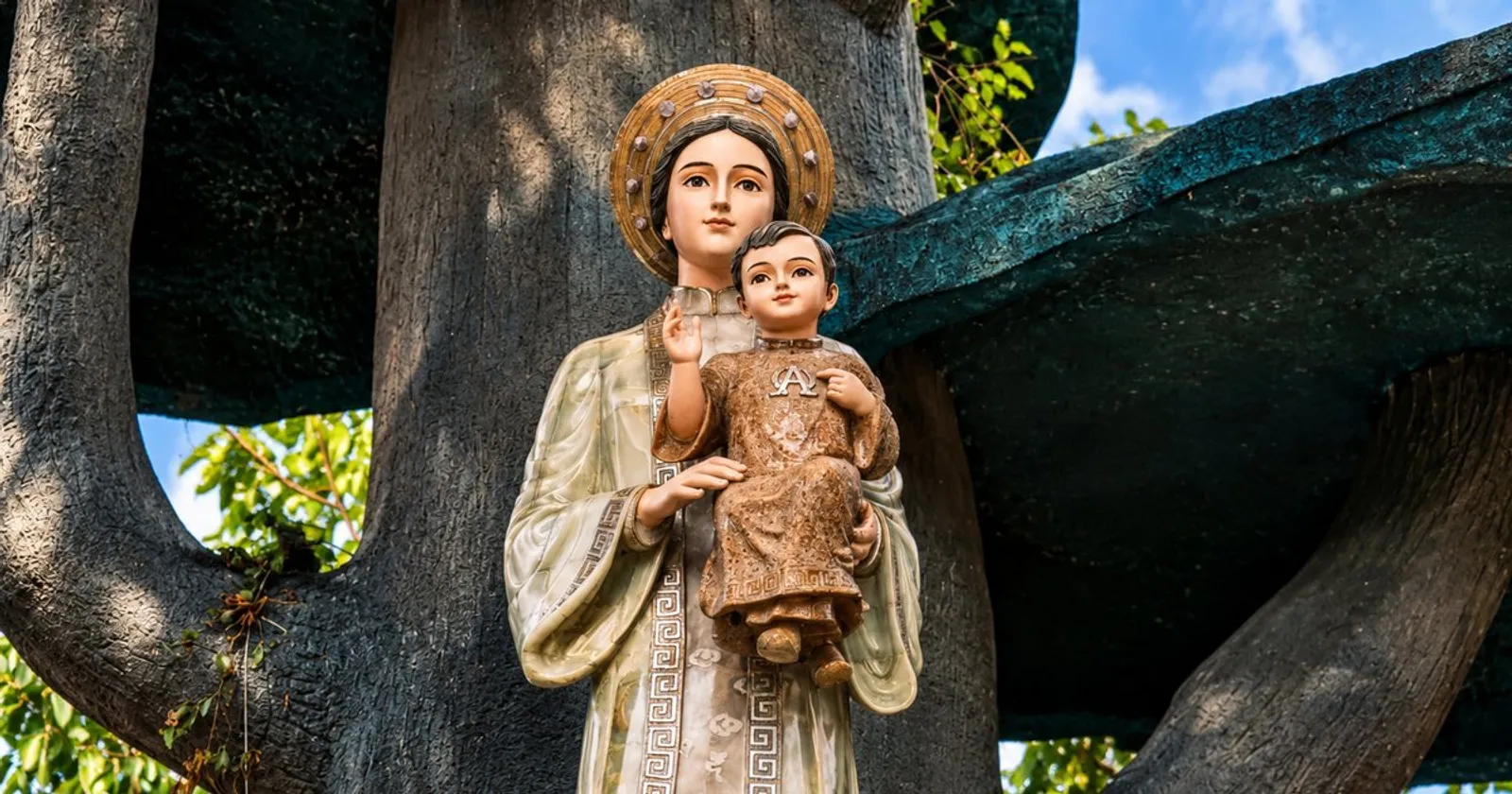
The statue platform (Linh đài). The statue of Our Lady of La Vang stands under three concrete banyan trees that recall the trees of the 1798 story. These concrete trees were the only structures at the statue platform still standing after 1972. The monthly pilgrimage Mass is held here.
The Martyrs' memorial. Behind the statue platform, a memorial honours the Vietnamese Martyrs.
Rosary Square (Quảng trường Mân Côi). The open square in front of the old tower, used for large Masses, camping and rest during pilgrimages.
The well. Many pilgrims drink a little water from the shrine's well as an act of devotion.
The new basilica. See the next section.
Is the new La Vang basilica finished?
The new La Vang basilica has been under construction since 2013, and no completion or consecration date has been confirmed. The first stone was laid on 15 August 2012 and construction began on 14 March 2013. As of July 2026, the Archdiocese of Huế was still publishing monthly donor lists for the building, and the 2026 Great Pilgrimage Masses were held on the basilica's outdoor altar platform.
The design follows Vietnamese architecture: curved tiled roofs that recall the Vietnamese communal house (đình), on a 13,464 m² footprint with seating for 5,000 people, according to the design brief published by the Archdiocese of Saigon.
When is the La Vang pilgrimage festival?
La Vang holds an annual pilgrimage on 14–15 August for the Feast of the Assumption, and a much larger national Great Pilgrimage (Đại hội Hành hương) at longer intervals. The 32nd Great Pilgrimage ran from 13 to 15 August 2026 on the theme "Mary, herald of the Good News", the first in nearly a decade.
Event | When | What happens | Source |
|---|---|---|---|
Annual Assumption pilgrimage | 14–15 August each year | 2025 programme: opening 16:00 and flower offering 16:30 on 14 Aug, vigil Mass 18:00; procession 04:30 and closing Mass 05:15 on 15 Aug | Archdiocese of Huế, programme dated 8 Jul 2025 |
32nd Great Pilgrimage | 13–15 August 2026 | Opening Mass 17:30 on 13 Aug presided by Archbishop Joseph Vũ Văn Thiên of Hanoi; 15 bishops attended | Dân Việt, 15 Aug 2026; Archdiocese of Huế |
First-Saturday pilgrimage Mass | First Saturday of every month | Mass at 08:00 at the statue platform | Archdiocese of Huế notices, Dec 2025 and Jan 2026 |
Next Great Pilgrimage | — | — |
Attendance figures for 2026 differ by source. The Hải Lăng commune People's Committee reported more than 170,000 people; the Archdiocese of Huế estimated about 150,000, the largest in ten years. Either way, mid-August is the busiest time of year at La Vang.
Operator advice for 14–15 August: the main Mass starts before sunrise. If you want to attend, sleep in Đông Hà or close to the shrine the night before rather than driving up from Huế in the early hours, and book rooms early. Expect road closures and long walks from parking. If you want a quiet visit, avoid the week of 15 August entirely.
How do you get to La Vang?
Most international visitors reach La Vang by private car from Huế, 60 km to the south and about 1 hour 45 minutes away, either as a half-day trip or as the first stop on a DMZ day. La Vang lies on the way from Huế to the former town of Quảng Trị, so it adds little extra driving to any trip north.
From | Mode | Distance | Driving time |
|---|---|---|---|
Quảng Trị Citadel | Private car | 7 km | About 20 min |
Đông Hà railway station | Private car | 20 km | About 40 min |
Huế city | Private car | 60 km | About 1 h 45 min |
Huế (Phú Bài) airport | Private car | 80 km | About 2 h |
Đồng Hới airport | Private car | 140 km | About 2 h 30 min |
Đà Nẵng | Private car | 170 km | About 3 h 20 min |
Phong Nha | Private car | 177 km | About 3 h |
Distances and times are Google Maps driving routes to the La Vang pilgrimage centre, checked by World Mate Travel in October 2026. Allow extra time on 14–15 August, when roads near the shrine are congested.
International visitors also need a valid entry permit for Vietnam; see our Vietnam e-visa guide.
Can you combine La Vang with a DMZ tour?
Yes. La Vang fits easily into a DMZ day from Huế because it sits on the route north. A full day can run Huế → La Vang → Quảng Trị Citadel → Hiền Lương Bridge on the Bến Hải River → Vĩnh Mốc Tunnels → Huế. Khe Sanh adds about three hours of driving each way, so most groups split it into a second day.
The Quảng Trị Citadel is the natural second stop, 7 km and about 20 minutes from La Vang. Its 81-day battle, from 28 June to 16 September 1972, was part of the same fighting that destroyed the La Vang church. Visiting both on one morning helps explain why so little of the 1928 church survives.
What is the best time to visit La Vang?
The most comfortable months to visit La Vang are January to April, when the weather is cooler and the site is quiet. May to August is dry but very hot, with little shade on the open squares. September to December is the main rainy season on the Central coast, with flood risk that can close roads.
Months | Weather in Quảng Trị | Crowds at La Vang |
|---|---|---|
January–April | Cooler, lighter rain | Quiet, except first Saturdays |
May–August | Hot and mostly dry; little shade on site | Very busy around 14–15 August |
September–December | Main rainy season; flood risk, especially October–November | Quiet |
For a month-by-month view of all regions, see our guide to the best time to visit Vietnam by region and month.
What should you wear and bring to La Vang?
La Vang is an active place of worship, so cover your shoulders and knees, speak quietly near the statue platform and inside the basilica, and keep your phone silent during Mass. Bring a hat, sunscreen and water, because the squares are wide and open. Comfortable shoes help on the walk between the old tower and the basilica.
Ask before photographing people at prayer, especially during Mass.
Do not climb on the ruins of the old bell tower.
Candles and flowers for offering are usually sold near the gate.
Do non-Catholics visit La Vang?
Yes. La Vang draws visitors of every faith. AsiaNews has reported that Buddhists and Protestants also come to pray to Our Lady of La Vang. For non-Catholic travellers the site is also a direct way to understand the history of Catholicism in Vietnam and what happened in Quảng Trị in 1972.
If you are interested in other Marian shrines in Vietnam, read our guide to Our Lady of Núi Cúi in Đồng Nai.
Frequently asked questions about La Vang
Our Lady of La Vang is in Hải Lăng commune, Quảng Trị province, Central Vietnam, about 60 km north of Huế. Before July 2025 the address was written as Hải Phú commune, Hải Lăng district. The shrine belongs to the Catholic Archdiocese of Huế.
La Vang holds a pilgrimage every year on 14–15 August for the Feast of the Assumption. The larger national Great Pilgrimage takes place at longer intervals; the 32nd Great Pilgrimage ran from 13 to 15 August 2026.
Yes. Pope John XXIII raised the La Vang church to a minor basilica on 22 August 1961 with the papal brief Magno Nos. In the same year the bishops of Vietnam named La Vang the National Marian Centre.
La Vang is 60 km north of Huế, about 1 hour 45 minutes by car (Google Maps, October 2026). Most visitors go by private car, either as a half-day trip or as the first stop of a DMZ day, because the shrine lies on the way from Huế towards the former town of Quảng Trị.
Yes. Visitors of any faith can enter the shrine grounds. Buddhists and Protestants also come to pray to Our Lady of La Vang. Dress modestly, keep quiet near the statue platform during Mass, and ask before photographing people at prayer.
Yes, with an early start. A full day from Huế can cover La Vang, the Quảng Trị Citadel, Hiền Lương Bridge and the Vĩnh Mốc Tunnels. Adding Khe Sanh makes the day too long for most travellers, so split it over two days.
No formal Vatican ruling on the 1798 apparition has been published. What the Holy See has recognised is the shrine: Pope John XXIII made the La Vang church a minor basilica on 22 August 1961. Some pilgrimage tour sites describe La Vang as Vatican-approved, which overstates its status.
The name is usually explained as coming from lá vằng, a plant that once grew thickly in the La Vang forest. The University of Dayton's Marian Library describes it as a fern. A second explanation reads La Vang as crying out for help, linked to the Catholics who hid there in 1798.
The tree-shaped structure is the statue platform of Our Lady of La Vang, called the Linh đài in Vietnamese. Its three concrete banyan trees recall the trees where tradition says the Virgin Mary appeared in 1798. They were the only structures at the platform still standing after the fighting of 1972.
The statue at La Vang shows the Virgin Mary in traditional Vietnamese costume, the áo dài, because she is venerated as the mother of Vietnamese Catholics. Vietnam's bishops describe La Vang as proof that a person can be fully Catholic and fully Vietnamese at the same time.
Around One and half hour is enough to see the old bell tower, the statue platform, the Martyrs' memorial, Rosary Square and the new basilica. Add time if you want to attend Mass, and much more on 14–15 August, when crowds and parking slow everything down.
Yes. The shrine runs a Pilgrim House (Nhà Hành hương) that opened in 2005, with more than 4,000 m² of individual and group rooms, a chapel and a dining hall. It is used most during the August pilgrimage. Travellers who want a hotel usually stay in Đông Hà or Huế instead.
Do not count on it. Visitor reviews report that taxis rarely come out to La Vang to collect passengers. Book a car for the return trip before you go, or keep the same car and driver waiting while you visit, which is how most private tours from Huế or Đông Hà run.
Regular Masses at La Vang are celebrated in Vietnamese. Foreign groups travelling with their own priest can ask the La Vang pilgrimage centre for permission to celebrate Mass; a bishop from California, for example, has celebrated Mass at the shrine during a visit. Arrange this before you travel.
There is no railway station at La Vang. Most train travellers get off at Đông Hà station on the North–South line, 20 km from the shrine, and continue by pre-booked car for about 40 minutes. Huế station is the other option if you are combining La Vang with a stay in Huế.
Yes. La Vang lies on the road north from Huế towards Đông Hà and Phong Nha, so a private car can stop there with little extra driving. La Vang to Phong Nha is 177 km, about 3 hours by car. Plan an early start, because the same road also passes the Quảng Trị Citadel and the DMZ sites.
Yes. La Vang is an active place of worship, so cover your shoulders and knees, especially inside the basilica and at the statue platform. Keep your voice low, silence your phone during Mass and ask before photographing people at prayer. Bring a hat, because the squares have little shade.
Planning La Vang with Huế or the DMZ? Email sales@worldmatetravel.com or WhatsApp +84 988 660 505, and a trip designer in Hanoi replies within 24 hours.