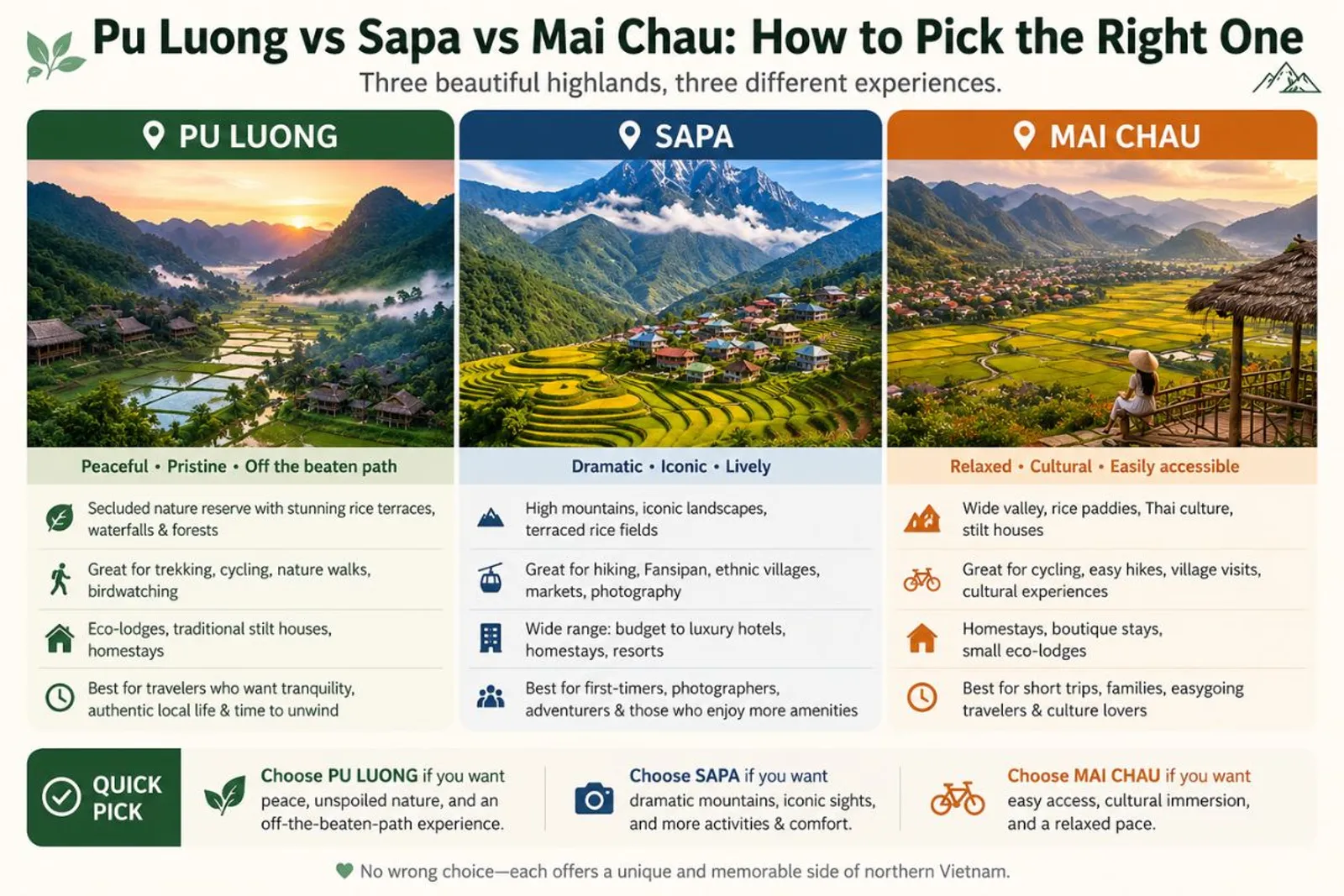
About a third of our inbound clients arrive in Hanoi having already chosen Sapa. About a third have heard "somewhere quieter" from a friend and want options. The last third have no idea these three places exist and ask us where to send them.
This post is for all of them. We run trips to Sapa, Pu Luong, and Mai Chau every week of the year. Each one is a different kind of trip, and the choice usually comes down to four things: how much time you have, how many other tourists you're willing to see, what altitude you want to wake up at, and what you actually plan to do up there.
The short version
| Sapa | Pu Luong | Mai Chau |
|---|---|---|---|
Drive from Hanoi | 5–6 hours (or overnight train) | 3.5–4 hours | 3 hours |
Valley elevation | ~1,500 m | 300–500 m | ~400 m |
Crowd level | High, year-round | Moderate, growing | Moderate (busy on weekends) |
Best known for | Fansipan summit, big views, cable car | Rice terraces, trekking, eco-lodges | Stilt-house villages, easy biking |
Lodging style | International hotels to homestays | Eco-lodges and homestays | Stilt-house homestays and boutique resorts |
Suits | Travelers who want mountain views with full hotel comfort | Travelers who want quiet, walking, and authentic village stays | Travelers short on time or with kids in tow |
That table answers about half of the questions we get. The rest is below.
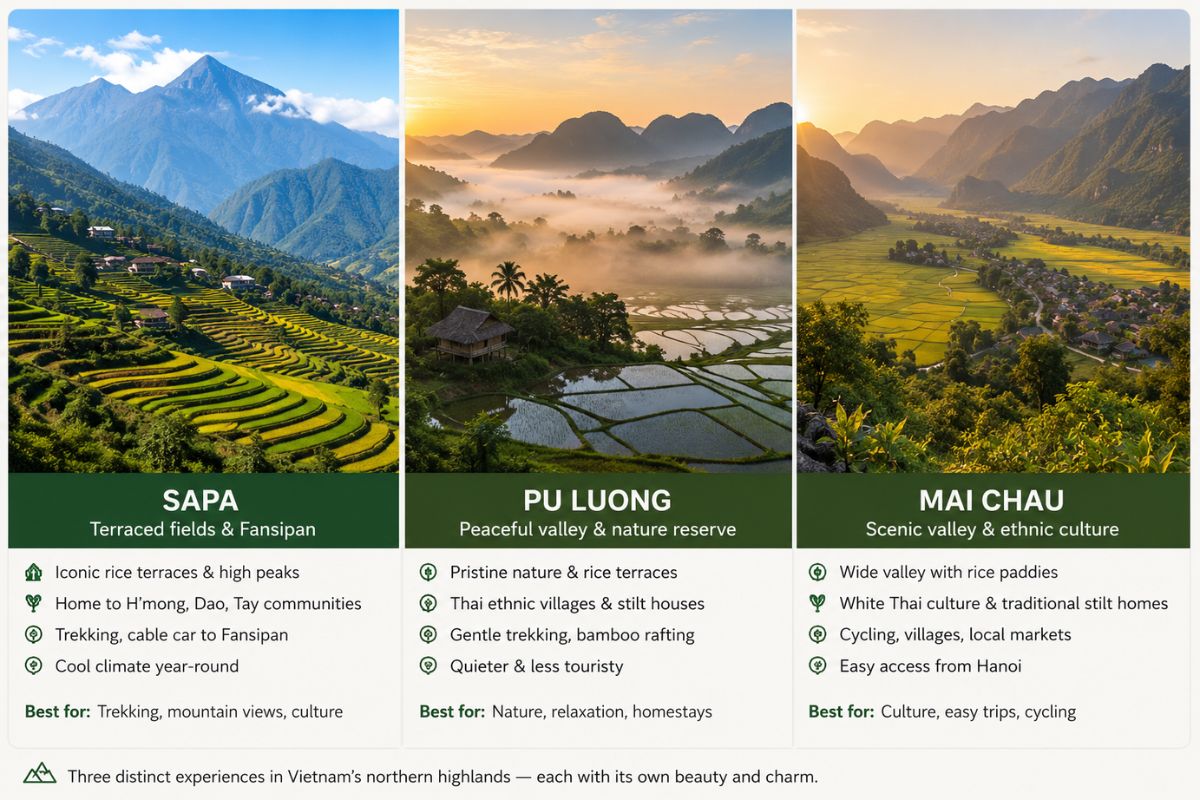
Sapa: the famous one
Sapa is the big draw. It sits at 1,500 metres in Lao Cai province, near the Chinese border, with Fansipan (3,143 m, the highest peak in Vietnam) a cable-car ride away. The town itself has hotels at every price point, including some of the most expensive rooms in northern Vietnam.
What you'll do in Sapa: ride the cable car up Fansipan, walk into the H'mong and Red Dao villages around the valley (Cat Cat, Ta Phin, Lao Chai, Ta Van), and look at terraced rice fields from elevation. The views are the reason people come, and on a clear day they earn their reputation.
The trade-off: Sapa town is busy. Weekends bring a heavy domestic Vietnamese tourist load. The road in is good (expressway most of the way from Hanoi), but the town itself has lost much of the rough edge it had ten years ago. Fog is common — there are weeks in spring when the cable car runs but you can't see anything from the top.
We send clients to Sapa when they want the iconic photographs, when they want a comfortable hotel at altitude, or when they specifically want Fansipan.
Pu Luong: the quiet one
Pu Luong is a nature reserve in Thanh Hoa province, about half the drive of Sapa from Hanoi. The valley sits between 300 and 500 metres, with peaks rising to around 1,700 metres around the edges. The terraced fields, water wheels, and stilt houses belong to the White Thai community who live in villages like Don, Hieu, and Kho Muong.
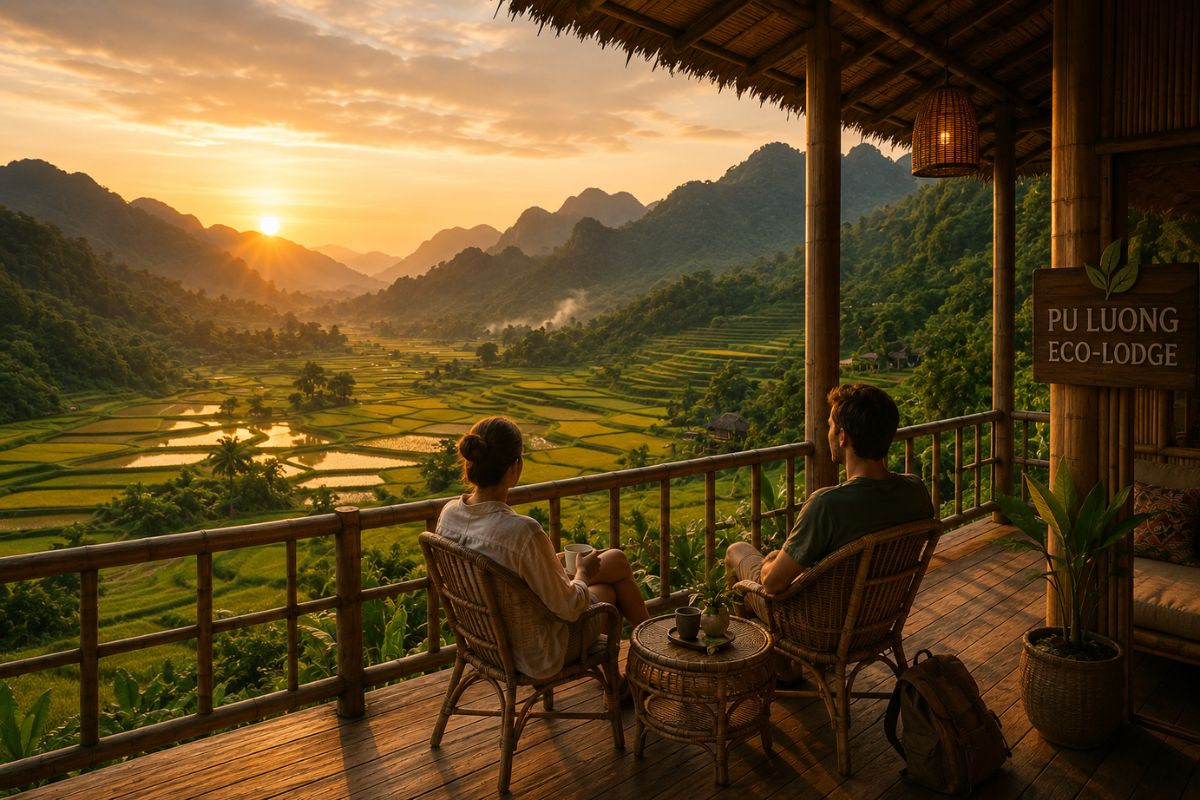
What you'll do in Pu Luong: trek between villages (three to six hours a day depending on your fitness), swim in waterfall pools, sit on the deck of an eco-lodge looking at rice fields, and eat dinner at a homestay where the host's mother cooks. It's a walking holiday in a place where there are still very few foreign tourists.
The trade-off: there is less to "see" than Sapa. No cable car, no famous peak, no big town. If you want a checklist of attractions, Pu Luong won't give you one. The road in winds through hills for the last hour, which doesn't suit everyone's stomach. Mid-range eco-lodges (Pu Luong Retreat, Puluong Eco Garden, Treehouse-style properties) have improved a lot in the last five years but international five-star hotels don't exist here yet.
We send clients to Pu Luong when they want walking, quiet, and a sense of being in rural Vietnam without the staged feeling Sapa can have. It's also the right pick for travelers who want to combine a few days of nature with a Halong Bay or Ninh Binh leg.
Mai Chau: the easy one
Mai Chau is the closest of the three to Hanoi — about three hours by road through Hoa Binh province. The valley floor is at around 400 metres, ringed by limestone hills. White Thai stilt-house villages (Lac, Pom Coong) sit in the middle of rice paddies.
What you'll do in Mai Chau: bike the loop through the villages (the valley is flat and the loop is about 7–10 km), watch traditional dances at a stilt-house homestay, eat sticky rice steamed in bamboo, and look at the valley from a couple of viewpoints. Mai Chau Ecolodge and Mai Chau Hideaway run on the more comfortable end if you want a pool and a proper restaurant.
The trade-off: Mai Chau is the most "domesticated" of the three. The performance dances at homestays are commercial — White Thai culture is real, but the way it gets presented to weekenders is polished. Crowds spike on Friday-to-Sunday with Hanoian families on a short break.
We send clients to Mai Chau when they have two or three days, kids in tow, or when they want a soft introduction to rural Vietnam before heading somewhere wilder. It's also the easiest day-and-a-half add-on to a Hanoi trip.
How we choose between them
The shortcut we use with clients goes like this:
You have less than two days outside Hanoi: Mai Chau. The drive is short enough that a one-night stay still feels worthwhile.
You want to walk a lot: Pu Luong. The trekking is the point of going.
You want to see Fansipan or the cable car or both: Sapa, no contest.
You're traveling with parents or young kids: Mai Chau first, Pu Luong second if everyone's mobile.
You want photographs of vast terraced fields with a mountain behind: Sapa in September, or Pu Luong in late May and again in late September.
You want a quiet eco-lodge with a pool over rice paddies: Pu Luong.
You hate fog: Pu Luong and Mai Chau over Sapa. Sapa fog is part of the experience for some people and a deal-breaker for others.
Best months for each
The seasons overlap but the timing is slightly different in each:
Destination | First rice harvest (green-to-gold) | Second harvest | Cold/foggy | Hot/wet |
|---|---|---|---|---|
Sapa | late May | late September | November–February | June–August |
Pu Luong | late May to early June | late September to early October | December–January (mild) | June–August |
Mai Chau | late May | late September | December–January (mild) | June–August |
The two harvest windows — late May to early June, and late September to mid-October — are when the terraces are at their peak. Those are also our busiest booking periods.
What we'd do with a week
If a client has seven days in the north and asks us to plan it, we don't usually pick one of these three over the others — we combine. Two nights in Mai Chau on the way out from Hanoi to acclimatise, three nights in Pu Luong for walking, and back to Hanoi via Ninh Binh. We'll add Sapa if the client specifically wants Fansipan or already has nine to ten days. With less than five days outside Hanoi, we usually skip Sapa entirely — the drive eats too much of the trip.
That's our reasoning. Yours might be different. If you tell us what kind of trip you want, we'll tell you which of the three actually fits.